
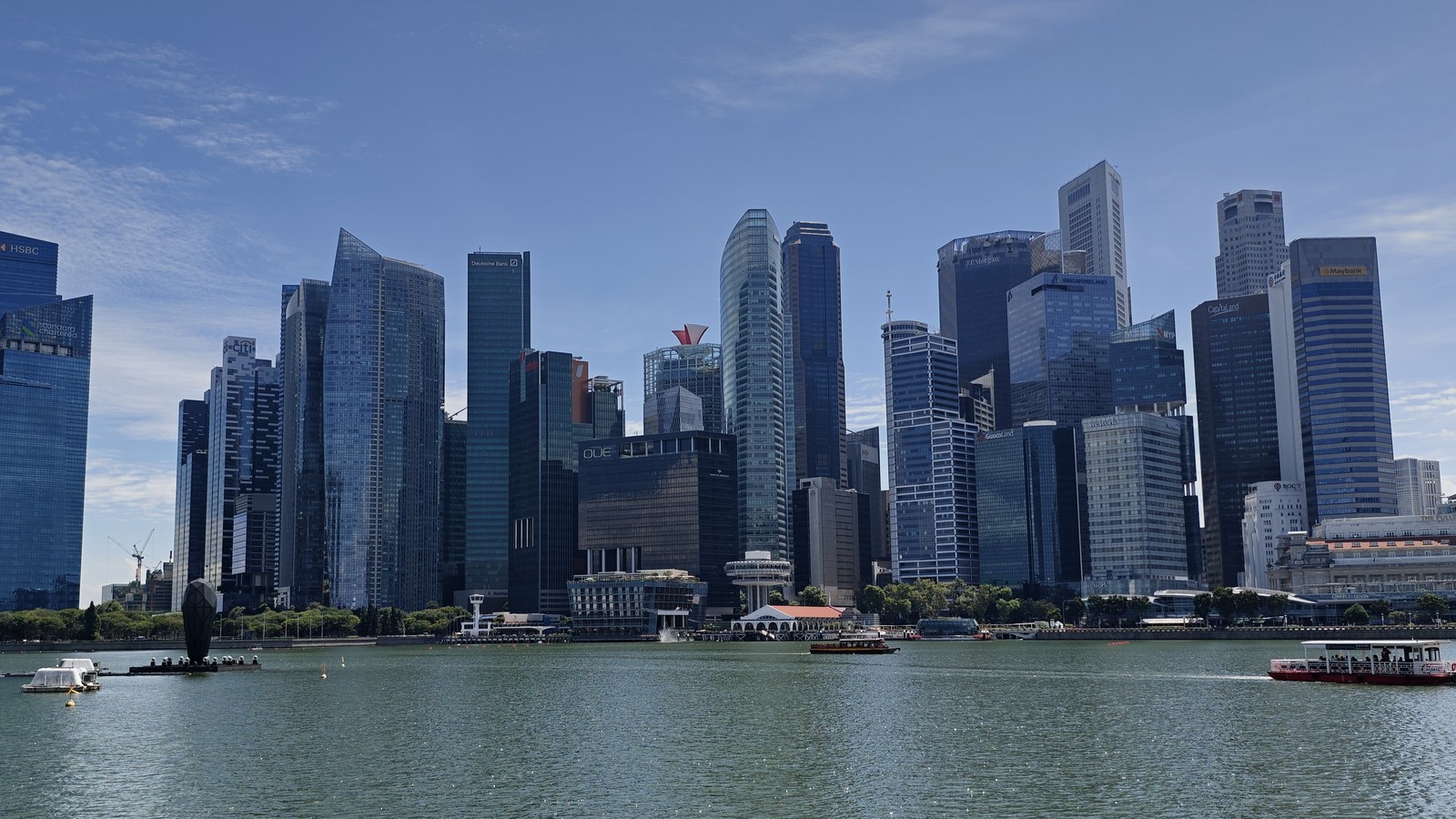
On 2 October the US Bureau of Labor Statistics reported that nonfarm payrolls rose by 29,000 in September, against a Dow Jones consensus of 84,000. July and August were revised down by a combined 60,000 — August from +162,000 to +133,000, July from a gain to a loss of 10,000. Unemployment edged up to 4.2%. Five days later the minutes of the Federal Reserve’s 15–16 September meeting showed that most participants still assessed another increase in the federal funds rate “would likely be appropriate by year end.” In Singapore, CBRE reported on 30 September that Core CBD Grade A office rents rose 2.0% in the third quarter to S$12.75 per square foot a month, the fastest quarterly gain since 2022, with vacancy down to 2.6%. And on 14 October the Monetary Authority of Singapore left its policy settings unchanged, although all 10 analysts in a Reuters poll published on 9 October had expected it to tighten again.
None of those prints moves a policy setting on its own. Together they define the interval wholesale investors are now standing in: MAS has held, the FOMC decides on 27–28 October, the RBNZ on 28 October, and New Zealand votes on 7 November. One policy decision in, two to come and an election on 7 November is exactly the setting in which waiting feels like prudence. For New Zealand income and Singapore freehold, it is not a reason to wait.
In September we wrote that the RBNZ’s 25 basis point hike to 2.75% matched the street, and that the Statement’s own track — a December-quarter average of 2.81% — read as a pause in October and a move to 3% in December. That reading has not been retired. What October adds is a wider street split in New Zealand, a softer US labour print set against a still-hawkish Fed, and a change of second market. From this edition the desk covers New Zealand and Singapore.
This edition covers:
- The interval: what has printed since the 2 September hike, and why the NZ street has split four ways ahead of 28 October
- The US signal that did not arrive: a weak September payrolls print against Fed minutes that still lean towards one more hike this year
- Singapore: tightening through the exchange rate, not an interest rate, and why MAS held its settings on 14 October
- Why NZ income and Singapore freehold are different trades, and how wide the yield gap between them actually is
- New Zealand and Singapore market updates, including the foreign-buyer and stamp-duty rules on Singapore commercial property
- Four new listings on the market this month, each large enough to need a syndicate, with their deadlines
1. The Interval: Between the Hike and the Next Decision
The RBNZ’s Monetary Policy Committee lifted the OCR to 2.75% on 2 September. The next decision is the Monetary Policy Review at 2pm on 28 October; the December Monetary Policy Statement follows on 9 December. Nothing between those dates is pre-committed. The Committee’s own words in September were that the future OCR path “is not pre-determined” and that its response to data “is not mechanical.”
The data since then has pulled in two directions. Stats NZ reported on 17 September that GDP rose 0.2% in the June quarter, after 0.9% in March, taking annual-average growth to 1.7% (2.6% on the June quarter a year earlier). Construction was the largest contributor, up 2.7% in the quarter — its largest rise since June 2023. According to NZ Adviser’s summary of the bank notes, all five major bank economics teams described the result as stronger than expected given the fuel shock running through the quarter. It was still a soft quarter. It was not a contraction.
On 6 October the NZIER Quarterly Survey of Business Opinion showed a net 40% of firms expecting better general economic conditions, up from 14% in the June quarter. Firms’ own trading activity told a different story: a net 1% reported a decline in the September quarter. Cost pressure eased — a net 47% of firms reported higher costs, down from 54% — and NZIER read hiring difficulty as a sign that “spare capacity in the New Zealand economy is dissipating.”
That gap is not noise. It is the same uneven recovery the RBNZ described in September — export-exposed and regional New Zealand supported by strong commodity prices, household-facing sectors under pressure, particularly in Auckland and Wellington — now visible in a single survey.
The street has read it four ways. Westpac’s 9 October forecast update keeps an October pause and a 25 basis point hike to 3% in December, while lifting its December-quarter CPI forecast to 4.2% on higher fuel prices and a weaker New Zealand dollar, and cutting its 2026 house price forecast from a small rise to a 1.4% decline. On the banks’ own latest notes, ASB (5 October) expects hikes at both October and December, taking the OCR to 3.25% by year-end; ANZ (21 September) expects an October move, a December pause, then hikes in February and March to a peak of 3.50%; BNZ (17 September) expects 25 basis points at every meeting until the OCR reaches 3.75%. Do not average them. The desk’s job is to name the range: on the published RBNZ track and Westpac’s house view, 28 October is a hold; on ASB, ANZ, and BNZ, it is a hike.
The RBNZ has not told the market whether 28 October is a pause or a hike. It has told the market the direction. For assets that already carry their income in the lease, the direction matters more than the date.
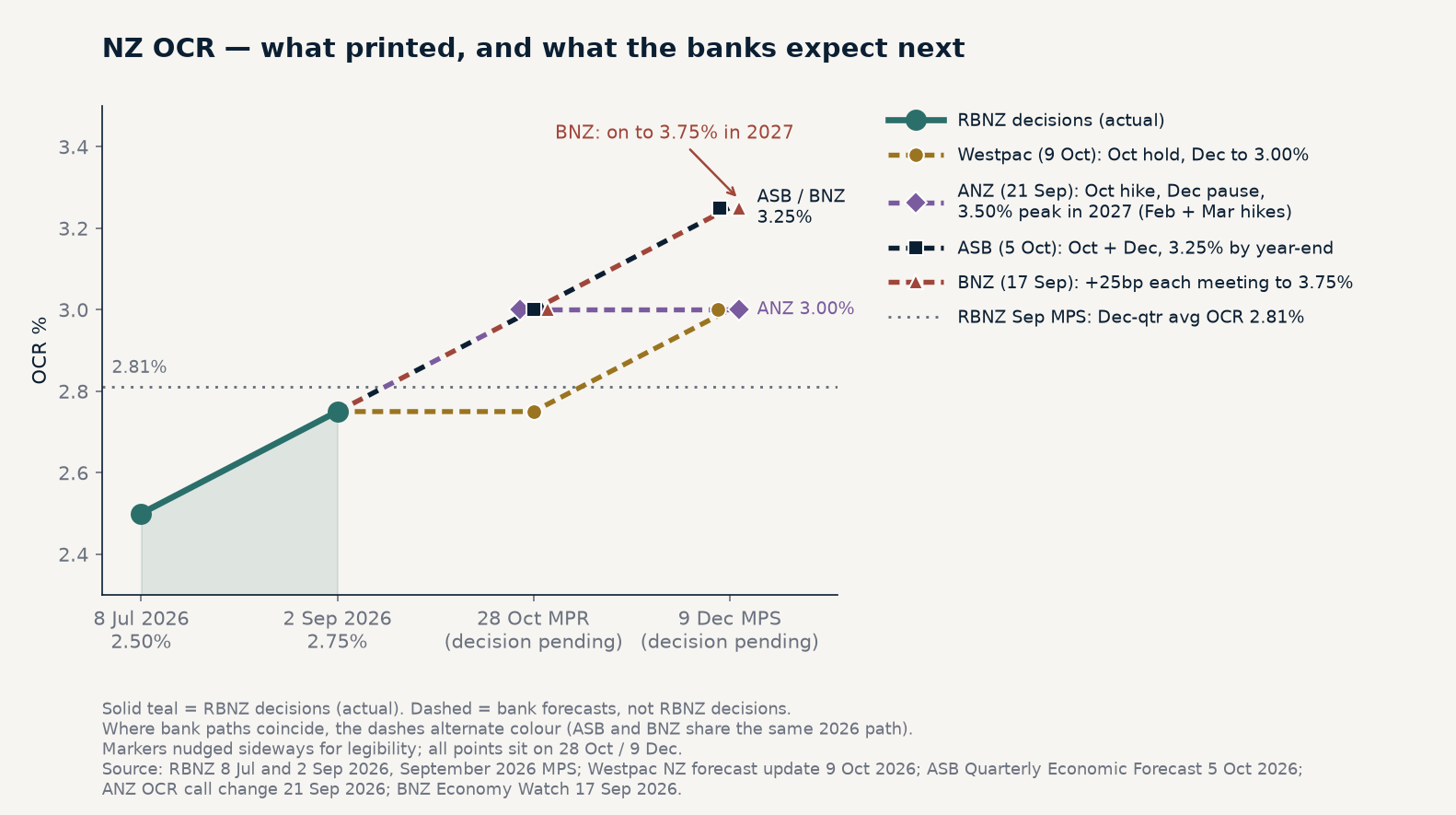
Source: RBNZ 8 Jul and 2 Sep 2026, September 2026 MPS; Westpac NZ forecast update 9 Oct 2026; ASB Quarterly Economic Forecast 5 Oct 2026; ANZ OCR call change 21 Sep 2026; BNZ Economy Watch 17 Sep 2026
2. The Signal That Did Not Come: Soft US Jobs, a Fed Still Leaning to Hike
Ordinarily, a payrolls miss of that size would reopen the easing conversation. It did not. On 2 October CNBC reported that market-implied odds of the Fed holding at its 27–28 October meeting jumped to 82.8% on CME FedWatch — a hold, not a cut. Average hourly earnings rose 3.0% over the year, the slowest annual pace since May 2021.
The Fed itself has not moved off its September posture. On 16 September the FOMC raised the target range by 25 basis points to 3.75–4.00%, unanimously, and the median projection put the federal funds rate at 4.1% at the end of both 2026 and 2027 — consistent with one more quarter-point increase and no cut next year. The minutes released on 7 October repeated the lean: most participants saw another increase as likely appropriate by year end, while stressing that each meeting would be approached “with an open mind.”
For NZ commercial property the transmission pipe is unchanged from August and September: long-end yields, the US dollar, and the ceiling on the 2026 rate headwind. For Singapore the pipe runs through the S$NEER and domestic interbank rates, with three-month compounded SORA at about 1.24% against a Fed target range of 3.75–4.00%. A softer US labour market lowers the odds of an October Fed move. It does not reverse the direction of travel. The signal the sidelines are waiting for — a turn to easing in the US — did not come in September’s data, and the Fed’s own projections do not have it arriving in 2027.
Investors waiting for the US to turn before committing to NZ income or Singapore freehold are waiting for a signal the Fed’s own median does not forecast.
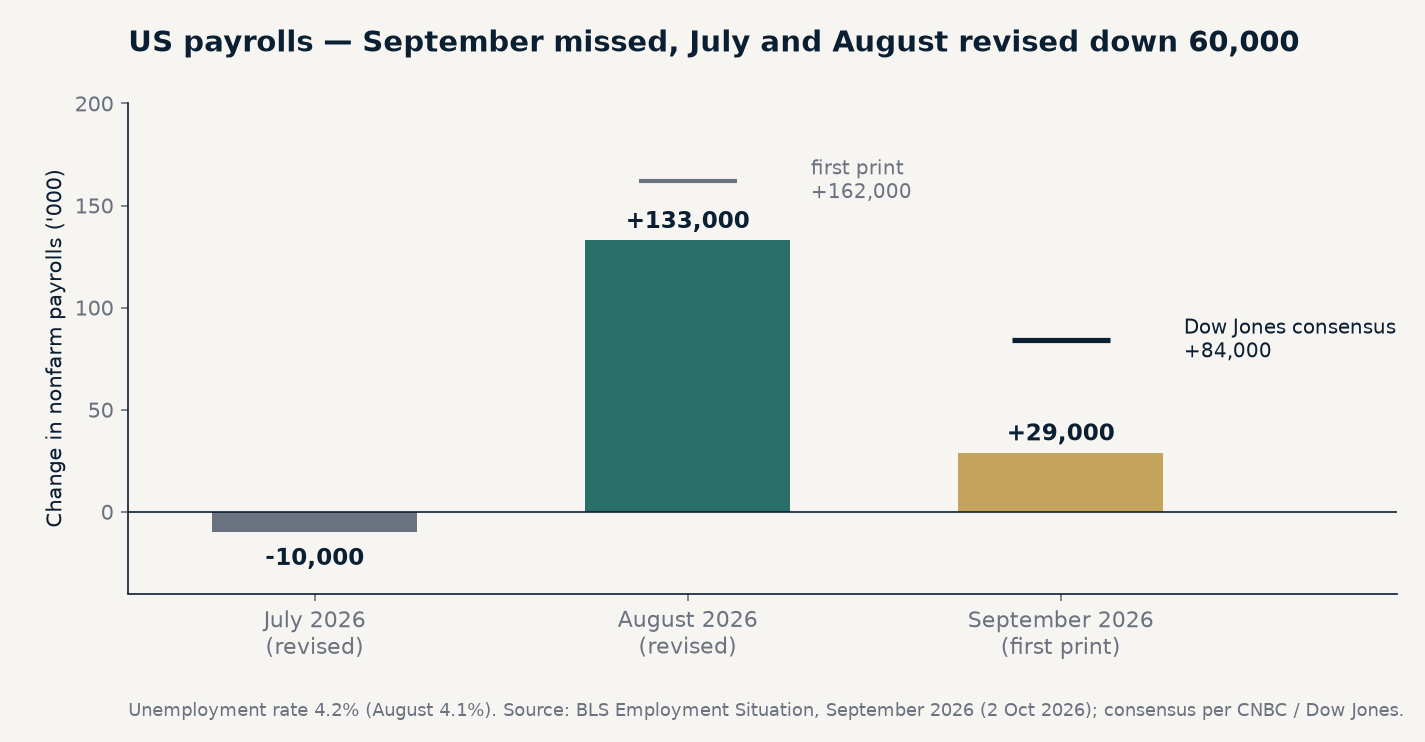
Source: BLS Employment Situation, September 2026 / Federal Reserve FOMC statement and SEP 16 Sep 2026 / FOMC minutes 7 Oct 2026 / CNBC 2 Oct 2026
3. Singapore: Tightening Through the Exchange Rate
MAS does not set an interest rate. It sets a path for the Singapore dollar nominal effective exchange rate, the S$NEER, inside an undisclosed policy band, and adjusts the band’s slope, width and centre at four scheduled reviews a year. On 14 April it increased the slope slightly. On 27 July it increased it again, “very slightly”, by less than in April, with no change to the width or the centre. The July statement said MAS Core Inflation was “projected to step up from July and remain elevated but should moderate discernibly from around mid-2027.”
The data since has followed that script. MAS and MTI reported on 23 September that core inflation rose to 2.2% in August from 2.0% in July — the highest since September 2024, according to CNA — with headline inflation at 2.3%. On 14 October MAS trimmed its 2026 forecasts to 1.5% to 2.0% for core inflation and around 2.0% for headline, from 1.5% to 2.5% for both, and projects both at 1.5% to 2.5% in 2027. Growth is running well ahead of plan: on 11 August MTI put second-quarter GDP 5.9% higher than a year earlier (since revised to 6.2%) and first-half growth at 6.1%, and lifted its 2026 forecast to 4.5% to 5.5% from 2.0% to 4.0%, citing the acceleration in global AI-related capital expenditure.
The street expected a third move. All 10 analysts polled by Reuters, in a poll published on 9 October, expected MAS to tighten on 14 October; Barclays’ Brian Tan, who looked for another slight increase in the slope, had argued that growth was feeding into inflation more mildly than MAS expected. MAS did not move. It said it “will therefore maintain the rate of appreciation of the policy band”, with “no change to the width of the band and the level at which it is centred”, and that the current band “will allow the S$NEER to continue to strengthen and lean against the anticipated near-term rise in imported inflation.” The same morning, the advance estimate from the Ministry of Energy, Trade and Industry (METI) put third-quarter GDP 5.4% higher than a year earlier, moderating from 6.2% in the second quarter, and 1.1% higher than the previous quarter on a seasonally adjusted basis. MAS expects the economy’s positive output gap to narrow through 2027; METI will announce its 2026 and 2027 growth forecasts in November.
For property, the more useful number is the one MAS does not set. Three-month compounded SORA, the benchmark for SORA-linked Singapore property loans, was 1.24% on MAS’s 14 October publication; CBRE recorded 1.15% on 23 July, up from a trough of 1.02% in April. A tighter currency path has not made local money expensive. That matters for an asset class that yields about 3.25% to 3.80% (CBRE’s March range for prime offices, as reported by Singapore Business Review): a lower income line can still carry modest leverage when the local base rate, before bank margins, is less than half the RBNZ’s OCR.
Singapore tightens by letting its currency rise, not by raising the cost of borrowing. For a freehold buyer that is a firmer store of value with cheap local debt. It is not an income story.
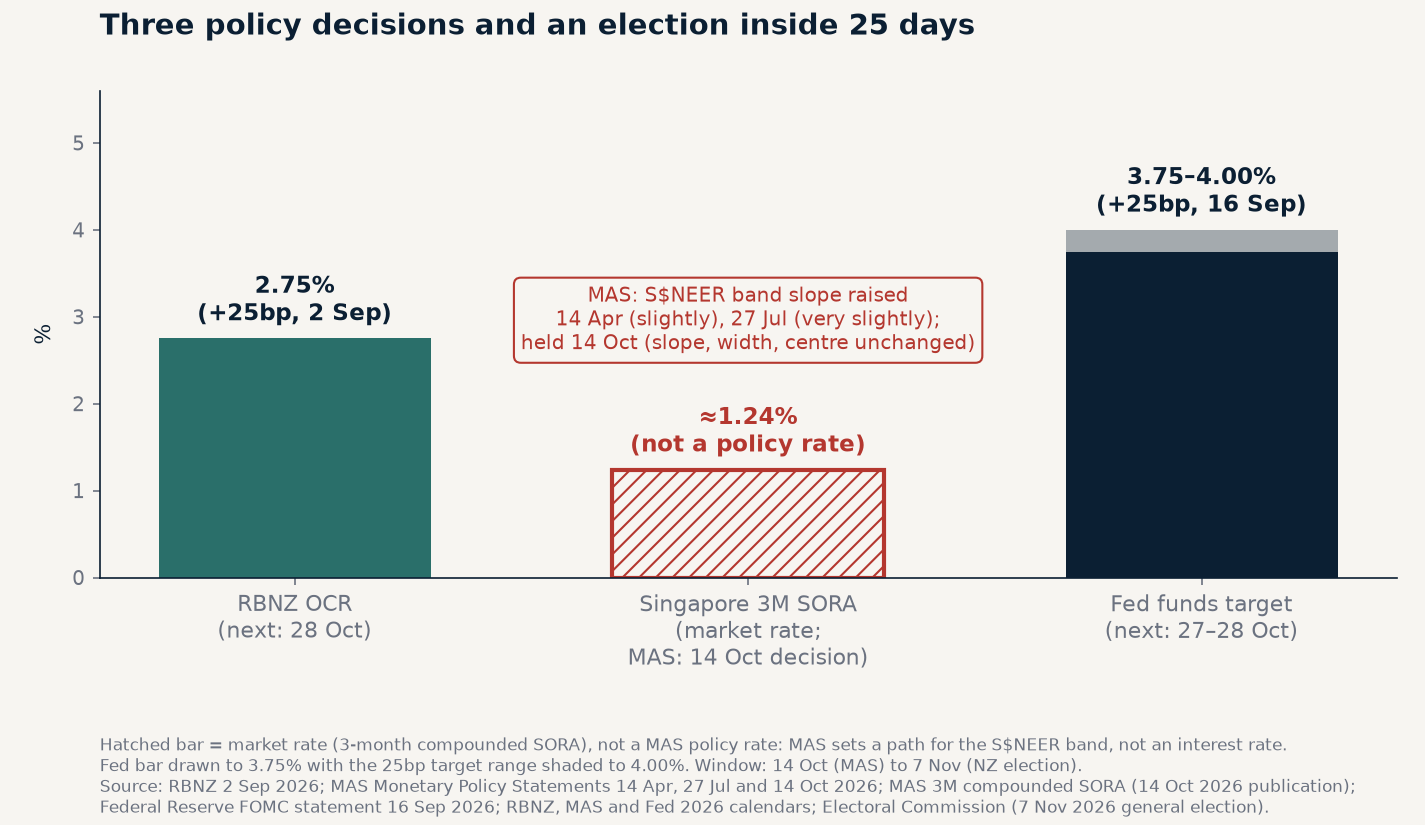
Source: RBNZ 2 Sep 2026 / MAS Monetary Policy Statements 14 Apr, 27 Jul and 14 Oct 2026 / MAS 3-month compounded SORA (14 October 2026 publication) / Federal Reserve 16 Sep 2026 / MAS–MTI Consumer Price Developments 23 Sep 2026 / MTI 11 Aug 2026 / METI advance GDP estimates 14 Oct 2026 / Reuters poll via AsiaOne 9 Oct 2026 / Electoral Commission (7 Nov election)
4. Translate into Commercial Property: The Cost of the Interval
Waiting does not feel like a decision. It feels like prudence. Three policy decisions and an election inside 25 days make the case for prudence sound stronger than it is.
The arithmetic has changed with the second market, and it should be stated plainly. CBRE’s Asia Pacific Cap Rate Survey, as reported by Singapore Business Review, put indicative cap rates for Singapore Grade A offices in core locations at 3.25% to 3.80% in March, and multifamily and build-to-rent at 3.65% to 4.15%; CBRE expects the office range to compress further. JLL’s 8 September review has prime Auckland industrial trading at 5.00% to 5.50% and Christchurch at 5.75% to 6.50%. Midpoint to midpoint, that is a gap of roughly 170 basis points against Auckland and 260 basis points against Christchurch. On a large-format asset, that spread is significant annual income, and Singapore does not pay it. What Singapore offers in its place is freehold tenure, a currency MAS is steering higher, and some of the deepest institutional liquidity in the region: Cushman & Wakefield counts S$44.3 billion of investment sales in the first nine months of 2026, already above the previous full-year peak of S$36.8 billion set in 2017, as reported by Singapore Business Review (Knight Frank, on its own count as reported in the trade press, has S$42.4 billion).
In New Zealand, the income book is the same one we described in September: outskirt industrial in South Auckland, regional commercial yielding above 8%, social housing on government-aligned net leases, healthcare and essential services. A hike on 28 October makes leveraged entry less comfortable. A hold does not make it cheaper. Neither outcome changes the rent roll. Replacement costs are up since 2022 and construction pipelines are soft — NZIER’s architects’ measure points to reduced commercial and government construction work — so if conditions improve, yield-compression risk remains asymmetric to the upside.
In Singapore the case is not yield, and it should not be sold as one. It is capital preservation: freehold tenure, Core CBD Grade A vacancy at 2.6% on CBRE’s count with no major office supply before 2028 beyond Newport Tower in 2027, and an industrial market that JTC shows still rising — rents up 0.5% and prices up 0.6% in the second quarter, with occupancy at 89.1%. Cushman & Wakefield’s own read of the quarter, as reported by Singapore Business Review, is that investors are increasingly focused on income-driven returns over cap rate compression. At 3.25% to 3.80%, the income keeps a Singapore asset carrying. It is not what the buyer is being paid for.
High-yielding outskirt assets in supply-constrained corridors do not require rate cuts to perform. They require vacancy. The rate decision is a timing question; the income is already in the lease.
5. New Zealand Market Update
New Zealand is navigating a period of genuine difficulty, and we think it is more useful to address that directly than to frame it otherwise.
OCR 2.75% after consecutive hikes on 8 July and 2 September. Next decisions: 28 October (Review) and 9 December (Statement). The RBNZ’s September track is consistent with a December move to 3%; on their latest notes, three of the four major banks (ASB, ANZ, BNZ) expect a hike in October, and Westpac reaffirmed a hold on 9 October. Headline CPI was 4.1% in the June quarter on fuel; the RBNZ expects inflation back inside the 1–3% band by mid-2027 and at the 2% midpoint by late 2027. Stats NZ’s September-quarter CPI is due later in October, and Westpac expects 3.7%. That print, not the street debate, is the most important data point for the 28 October decision.
GDP rose 0.2% in the June quarter and 1.7% in the year to June (annual average). Business confidence has recovered sharply; trading activity has not yet followed. Households remain the weak lane — Westpac now expects house prices to fall 1.4% in 2026, and expects high fuel costs and a weak housing market to crimp consumer demand into Christmas. The general election on 7 November adds a layer of uncertainty to household and business decisions in the weeks after the Review.
For commercial property the practical implication is unchanged from July, August, and September: this is an income cycle, not a capital appreciation cycle. The listings that work in this market are the ones that pay through a hike, a hold, and an election result alike. Certainty is a lagging indicator. The income is already in the lease.
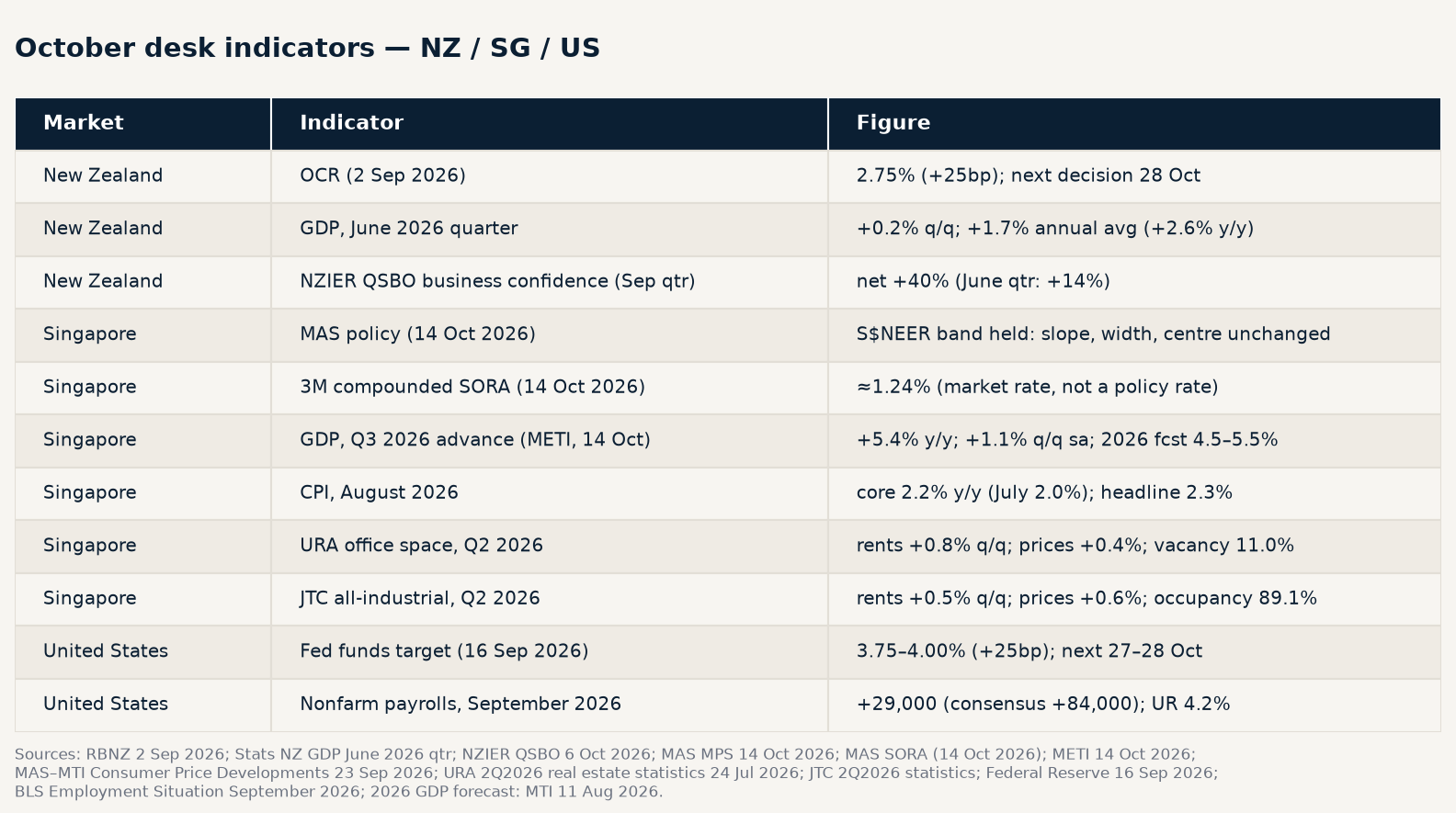
Source: RBNZ September 2026 MPS / Stats NZ GDP June 2026 quarter / NZIER QSBO 6 Oct 2026 / Westpac 9 Oct 2026 / MAS Monetary Policy Statement 14 Oct 2026 / MAS SORA / METI advance GDP estimates 14 Oct 2026 / MAS–MTI / URA / JTC / Federal Reserve / BLS / Electoral Commission (7 Nov election)
6. Singapore Market Update / The Freehold Case
In New Zealand the case is income. In Singapore the case is capital preservation, at a lower income. Both are valid. The mistake is applying the same framework to both.
Offices first. URA’s second-quarter statistics, released on 24 July, showed Central Region office rentals up 0.8% after a 0.2% fall in the first quarter, prices up 0.4%, and island-wide office vacancy edging up to 11.0% from 10.8% as new stock arrived. The prime end is tighter than that average suggests: CBRE’s third-quarter figures have Core CBD Grade A rents up 3.7% so far this year, and CBRE expects full-year growth above 5%, the strongest since 2022. URA’s third-quarter commercial statistics are due on 23 October.
Industrial has now recorded 23 consecutive quarters of rental growth on CBRE’s reading of the JTC series. JTC’s all-industrial rental index rose 0.5% in the second quarter and its price index 0.6%, and CBRE puts prime logistics occupancy at 95.7%.
For an offshore syndicate, zoning decides which Singapore assets are investable at all, and both Singapore assets featured this month are on commercial zoning. CBRE’s launch release puts 80/82 South Bridge Road on land zoned “Commercial” with a plot ratio of 4.2 under URA’s Master Plan 2025, and ERA describes 42–46 Smith Street as zoned for commercial use; URA’s published Master Plan 2025 land-use layer shows both sites as Commercial. That matters because IRAS charges Additional Buyer’s Stamp Duty only on residential property, and for a whole building with land, IRAS classifies the property by its Master Plan zoning: land zoned “Commercial” counts as wholly non-residential. A commercial or industrial building pays ordinary Buyer’s Stamp Duty and no ABSD, whether the buyer is a Singapore citizen, a foreigner or a company, and the Singapore Land Authority confirms that a foreign person can buy commercial and industrial property, and shophouses for commercial use, without approval under the Residential Property Act. For a syndicate vehicle, that is the difference between a deal that works and one that does not.
One line of caution: shophouses zoned “Residential with commercial at first storey” are mostly residential property for stamp duty, and ABSD on the residential share is 60% for foreigners and 65% for entities, including the trustee of a collective investment scheme.
Source: MAS / MTI / URA 2Q2026 real estate statistics 24 Jul 2026 / CBRE Singapore office Q3 2026 (30 Sep) and JTC Q2 commentary (23 Jul) / JTC 2Q2026 / CBRE Asia Pacific Cap Rate Survey Q1 2026 (as reported by Singapore Business Review) / Cushman & Wakefield Singapore Q3 2026 MarketBeat (as reported by Singapore Business Review) / Knight Frank via Stacked Homes / SLA, Foreign ownership of property / IRAS, ABSD and Definition of Residential Property / CBRE launch release 17 Sep 2026 (South Bridge Road) / ERA via EdgeProp 14 Sep 2026 (Smith Street) / URA Master Plan 2025 Land Use Layer (data.gov.sg)
Featured Listings
These are not Fairhaven listings. They are four assets on the open market this month through other agencies, chosen because each is large enough to need pooled capital and each restates this edition’s split (one, Smith Street, closes the day after publication and is included as a market note only): two New Zealand assets where the income is already in the lease, and two Singapore freehold commercial assets where the case is the land, not the yield, and where commercial zoning keeps ABSD out of the structure. Fairhaven acts for the buyer. Eligible wholesale investors can register interest in Hornby, Kerwyn Avenue or South Bridge Road with us (Smith Street is a market note only); we advise on the asset and on how an acquisition could be structured. All figures below are as published by the selling agent or in the launch reports; we have not estimated values or yields. The deadlines are short, and they are stated plainly.
New Zealand
Hornby, Christchurch — 13 Bruce Stewart Drive, Cold-Chain Logistics
On the market via CBRE (Tim Rookes, Bruce Catley, Claus Brewer, Chris O’Brien). Fairhaven: buy-side adviser and syndicate structurer.
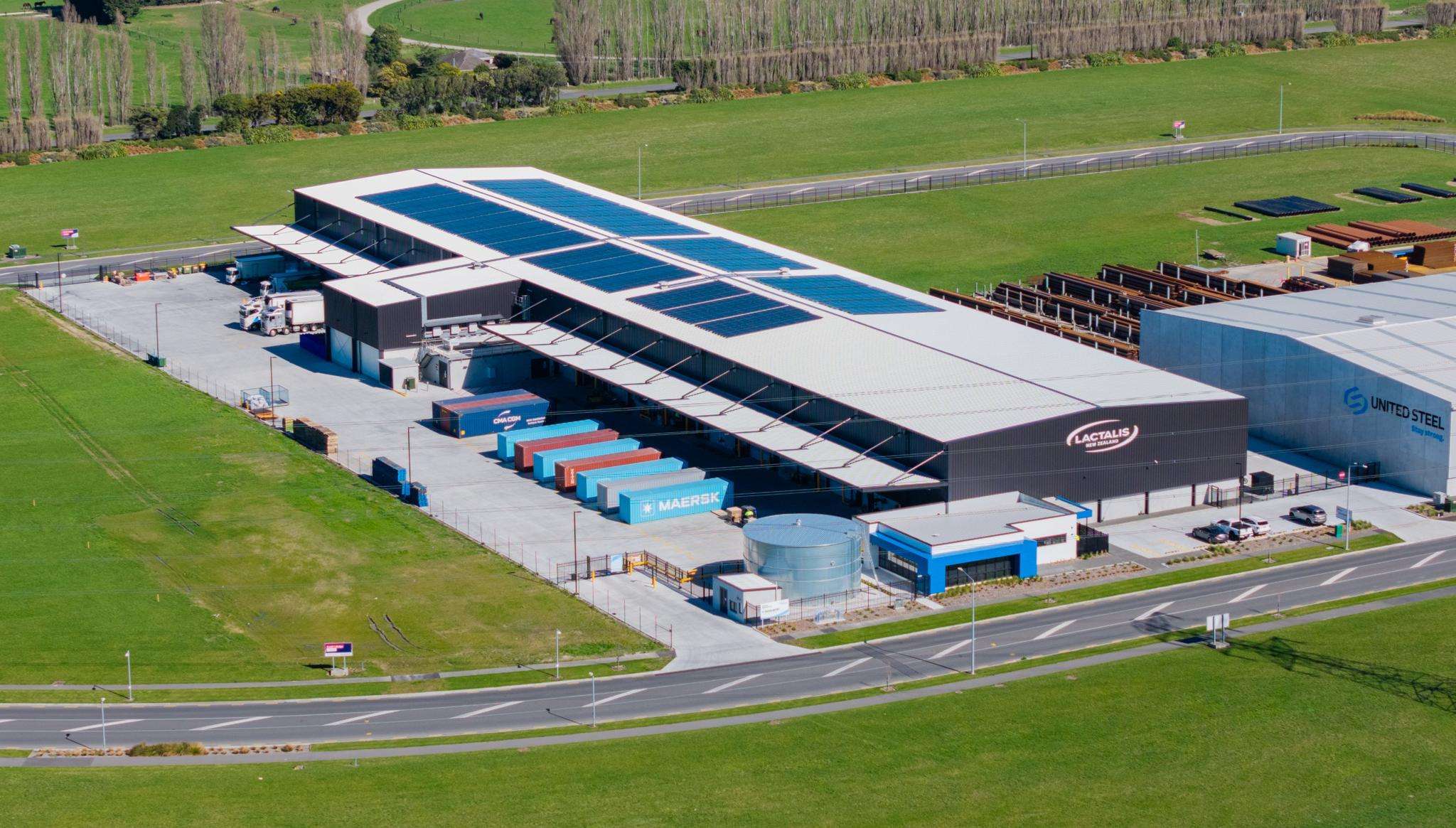
| Property Type | Purpose-built cold-chain logistics facility: chilled, freezer and ambient storage, loading tunnel, offices (completed 2026) |
| Sale Method / Closing | Deadline private treaty, closes 4pm Thursday 22 October 2026 (unless sold prior). Price not stated. |
| Net Income (as published) | NZ$2,206,901 + GST a year |
| Tenant / Lease | Fonterra Brands (New Zealand) Ltd, the lease entity of Lactalis (S&P A-). 15-year lease from April 2026; two 5-year rights of renewal to 2051 |
| Rent Reviews | Fixed 3.5% annual increases; market reviews every five years |
| Area | Approx. 8,600 sqm lettable on a 1.83 ha freehold site; 7,600+ sqm of yard |
Notes: Built by Calder Stewart and opened in early 2026 for Fonterra Brands’ New Zealand operations. Flanked by State Highway 1 and the Christchurch Southern Motorway, close to Christchurch Airport, Lyttelton Port and the Rolleston inland ports (CBRE release via OneRoof, 26 Sep). Listing: https://www.cbre.co.nz/properties/industrial/details/NZ-CCH101142/13-bruce-stewart-drive-hornby-canterbury-8042
Investment Potential: The income case at its cleanest. Fifteen years of term to an A- rated global dairy group, with 3.5% fixed annual growth written into the lease, means the rent roll does not care whether 28 October is a hold or a hike. The ticket needs pooled equity, which is the part we structure. The risks are real and should be priced: a single-tenant, special-purpose building that would be costly to re-lease, a Christchurch market less liquid than Auckland, fixed increases that may run ahead of market by the five-yearly reviews, and institutional competition into a 22 October deadline. Register interest with us this week.
East Tāmaki, Auckland — 100 Kerwyn Avenue, Industrial Landholding
On the market via Bayleys (Matt Mimmack, James Hill, Michael Nees), one of a four-property Auckland portfolio offered individually or together. Fairhaven: buy-side adviser and syndicate structurer.
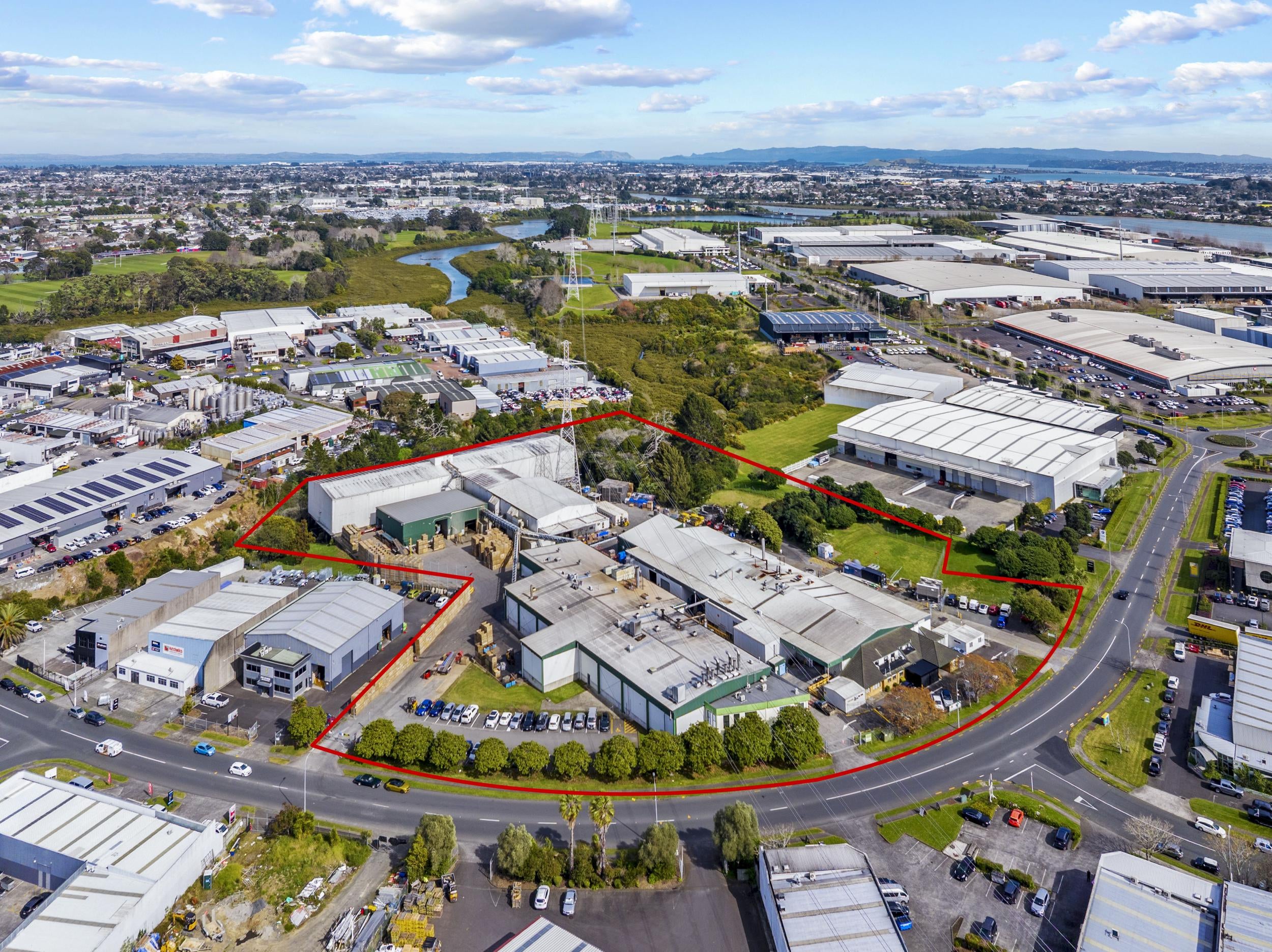
| Property Type | Industrial / food manufacturing: two manufacturing buildings, freezer and chiller facilities, grading areas and offices |
| Sale Method / Closing | Tender, closes 4pm Thursday 22 October 2026 (unless sold prior), Bayleys Takapuna. Price not stated. |
| Net Income (as published) | NZ$1,537,034.81 + GST a year |
| Tenant / Lease | Triple-net lease to Mr Chips Ltd to December 2032, one six-year right of renewal; fixed rent reviews |
| Security | Bank guarantee covering 24 months of rent and outgoings |
| Area | 26,174 sqm (2.6174 ha) of land zoned Light Industry; 9,340 sqm of improvements |
Notes: Three street crossings from Kerwyn Avenue, in the established East Tāmaki industrial hub. Bayleys is selling it individually or with the other three portfolio properties (Henderson, Auckland Central and Herne Bay). Listing: https://www.bayleys.co.nz/listings/commercial/auckland/manukau/100-kerwyn-avenue-east-tamaki-1507507
Investment Potential: A triple-net lease with a bank guarantee is about as passive as an income line gets: the tenant carries the outgoings, and the guarantee covers two years of them. Underneath sits 2.6 hectares of Light Industry land in one of Auckland’s main industrial hubs, which is the long-run value if the lease is not renewed. The risk to underwrite is term. Expiry in 2032 falls inside a typical syndicate hold, to a single tenant, in specialised food-processing buildings. Tender closes 22 October. Register interest with us this week.
Singapore
Central Area — 80/82 South Bridge Road, Six-Storey Freehold Commercial Building
On the market via CBRE (Ong Zhen Hao), exclusive, as part of a three-property portfolio that can be bought individually or together. Fairhaven: buy-side adviser and syndicate structurer.
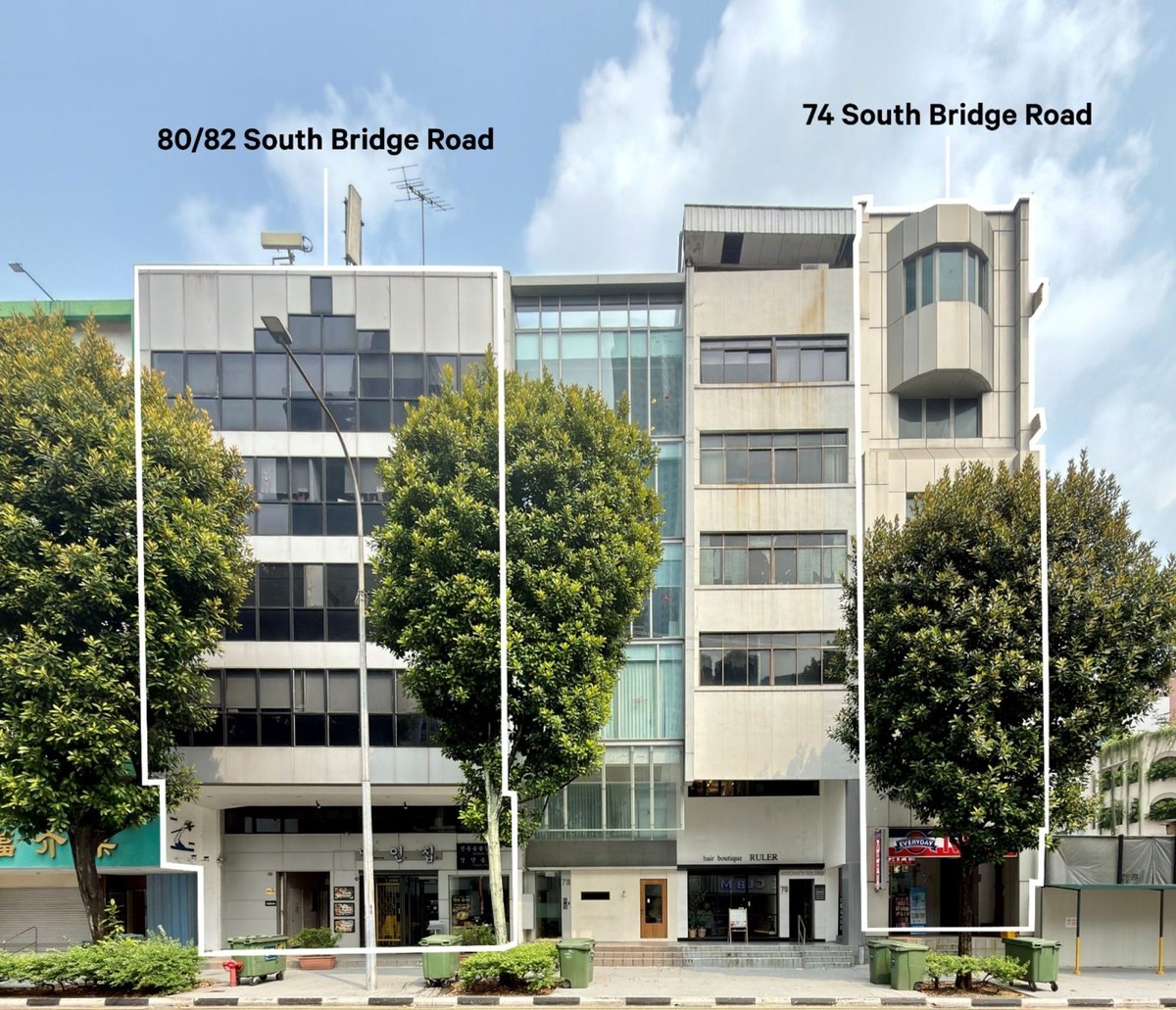
| Property Type | Six-storey commercial building; food and beverage approvals on Levels 1 and 2 |
| Guide Price / Sale Method | S$40 million guide (approx. S$4,062 psf on existing GFA; S$3,046 psf on maximum allowable GFA). Expression of interest closes 3pm Wednesday 21 October 2026. |
| Net Income (as published) | Not stated |
| Tenancy | Fully leased (per CBRE); tenants and lease terms not stated |
| Area | Land approx. 3,127 sq ft; existing GFA approx. 9,848 sq ft; potential to approx. 13,133 sq ft using unutilised plot ratio, subject to approvals |
| Tenure / Zoning | Freehold; zoned “Commercial”, plot ratio 4.2, URA Master Plan 2025 |
| Stamp Duty / Foreign Buyers | Commercial property: Buyer’s Stamp Duty only, no ABSD; open to foreign and corporate buyers without RPA approval |
Notes: Clarke Quay, Raffles Place and Chinatown MRT stations are a six- to ten-minute walk away (EdgeProp, 17 Sep). CBRE points to URA’s June 2026 circular easing restrictions on new hotels, backpackers’ hostels and serviced apartments in the Upper Circular Road area, which may open boutique-hospitality conversions, subject to approvals. The same CBRE portfolio includes 74 South Bridge Road, a fully leased six-storey commercial building a few doors down, at a S$20.5 million guide. Launch release: https://markets.businessinsider.com/news/stocks/rarely-available-portfolio-of-three-prime-freehold-assets-for-sale-1036552908 — report: https://www.edgeprop.sg/property-news/three-freehold-commercial-assets-south-bridge-road-frankel-avenue-sale-67-mil
Investment Potential: This is the Singapore case, not the New Zealand one. What the buyer gets is a whole freehold building on commercial zoning at the edge of the CBD, fully leased, with F&B approvals on the two street-facing floors and roughly a third more floor area available under the plot ratio, subject to approvals. Commercial zoning means no ABSD, so a syndicate vehicle pays the same stamp duty as any other buyer. CBRE has not published the rent roll, and CBRE’s March survey, as reported by Singapore Business Review, puts prime Singapore office cap rates at 3.25% to 3.80%, so the income is not what the buyer is being paid for. The tenancy schedule and lease expiries are the first things to see. Any serviced-apartment conversion would put a residential question back on the table and should go past Singapore counsel first. EOI closes 21 October. Ask us this week, or register interest.
Market note, closes 16 October: Chinatown — 42/44/46 Smith Street, Three Adjoining Freehold Conservation Shophouses
On the market via ERA Realty Network (Eva Lau), exclusive. Included as a market note: the expression of interest closes the day after this edition is published.
| Property Type | Three adjoining freehold conservation shophouses on a corner, with multiple frontages; major renovation completed 2023 |
| Guide Price / Sale Method | S$48 million guide. Expression of interest closes 3pm Friday 16 October 2026. |
| Net Income (as published) | Not stated |
| Tenancy | Fully leased: restaurant on the ground floor; JYU Capsule Hotel on the second and third floors under a long-term lease; a long-standing traditional Chinese medicine clinic in the attic. Lease terms not stated |
| Area | Land approx. 2,784 sq ft; built-up area approx. 9,500 sq ft |
| Tenure / Zoning | Freehold; zoned for commercial use (agent); Commercial on URA’s Master Plan 2025 land-use layer; conservation shophouses |
| Stamp Duty / Foreign Buyers | Commercial property: no ABSD, and foreign buyers can purchase (per the agent) |
Notes: Directly opposite Chinatown Complex and within walking distance of Chinatown and Maxwell MRT stations, on the North-East, Downtown and Thomson-East Coast lines. The Chinatown Business Association is rejuvenating Smith Street (EdgeProp, 14 Sep). No agent listing page is public; launch report: https://www.edgeprop.sg/property-news/rare-trio-adjoining-freehold-chinatown-shophouses-up-for-48-mil
Investment Potential: Three adjoining freehold shophouses under one owner in Chinatown are rare, and here they come fully let to three different trades, with the capsule hotel on a long-term lease and the building renovated in 2023. The case is scarcity and freehold tenure, not yield: ERA has not published the income. The tenant mix leans on tourism, and a single hospitality operator holds two of the floors. The EOI closes at 3pm on Friday 16 October, the day after this edition goes live, so we include it as a marker of where freehold commercial pricing sits rather than as a bid opportunity.
For more info on any of the above listings, or to register interest, contact the Fairhaven team directly. The deadlines are the agents’ own: 16 October for Smith Street (market note), 21 October for South Bridge Road, and 22 October for both New Zealand assets.
Petrus Yen — Petrus@fairhavenproperty.co.nz
Daarshan Kunasegaran — Daarshan.Kunasegaran@fairhavenproperty.co.nz
Disclaimer: The information provided is based on publicly available data and internal analysis. For informational purposes only. Not financial, legal or tax advice. The featured properties are marketed by the agencies named; details are as published by those agencies and may change or be withdrawn without notice. Property details and projections are indicative only. Readers should conduct independent due diligence, including on stamp duty and foreign-ownership rules, before making any investment decisions.
Fairhaven Property Group specializes in real estate investment opportunities across New Zealand, tailored specifically for wholesale investors as defined by the Financial Markets Authority (FMA). Please note, our offerings are not available to retail investors. For more information on what constitutes a wholesale investor, please visit the FMA's guidelines. Individuals who are tax residents outside of New Zealand are hereby advised to procure legal counsel or engage with the appropriate regulatory authority to assess their eligibility for investing with our entity, contingent upon their residency status.

